
An advertising agency Costa Mesa businesses choose should do more than create attractive ads; it should connect strategy, creative work, media, digital marketing, and measurement to produce results that actually matter.
For a local retailer, professional service firm, restaurant, healthcare practice, or growing e-commerce brand, that might mean generating qualified leads, increasing foot traffic, improving online visibility, or turning an unfamiliar name into one customers recognize.
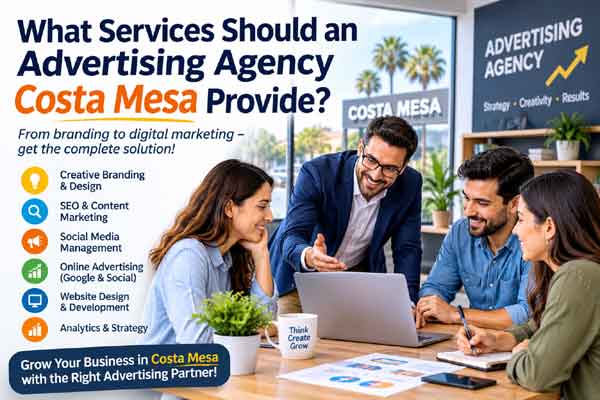
The right advertising agency Costa Mesa should therefore offer an integrated mix of services rather than treating advertising as a collection of disconnected campaigns.
Here are the core capabilities businesses should expect when evaluating an agency.
Table of Contents
Brand Strategy That Comes Before Advertising
Strong advertising usually begins before anyone writes a headline, designs a banner, or launches a paid campaign.
An agency should first understand the company’s audience, competitive position, goals, strengths, and reasons customers choose it over alternatives.
That research shapes the brand positioning and provides a clearer foundation for every campaign that follows.
Imagine two Costa Mesa fitness studios competing for essentially the same group of customers.
One could position itself around high-intensity workouts for busy professionals, while the other might emphasize personalized coaching and a welcoming environment for beginners.
Those distinctions influence everything from ad copy and photography to landing pages and audience targeting.
Without clear positioning, even beautifully produced campaigns can end up sounding remarkably similar to competitors.
Audience and Competitor Research
Customer research should go deeper than broad categories such as age, gender, or location.
A useful strategy considers what customers need, what frustrates them, how they search for solutions, which objections delay a purchase, and what ultimately convinces them to act.
Competitor analysis adds another layer by identifying crowded messages and opportunities for differentiation.
An agency might discover, for example, that every competing home services company emphasizes affordability while very few discuss punctuality, communication, or transparent estimates.
That gap could become the foundation of a much stronger advertising message.
Creative Development and Campaign Production
Once the strategy is clear, the agency needs the creative ability to turn it into advertising people actually notice.
Creative services can include copywriting, graphic design, photography, video production, campaign concepts, social media assets, display advertisements, print materials, and branded content.
Consistency matters because customers rarely encounter a business through only one channel.
Someone might first see a short video on Instagram, later notice a Google search ad, visit the website, and finally receive a retargeting advertisement before making an inquiry.
If each interaction looks and sounds like it came from a different company, trust can weaken.
A capable creative team develops recognizable visual and verbal elements while adapting the execution to each platform.
Video and Short-Form Content
Video has become especially important for businesses trying to communicate quickly.
A polished 15-second advertisement can demonstrate a product, introduce a service, answer a common objection, or show a customer transformation far faster than a long block of promotional copy.
The format should match the platform rather than simply recycling the same commercial everywhere.
A vertical social video, for instance, may need an immediate visual hook and captions, while a YouTube advertisement can allow slightly more time for storytelling and explanation.
Paid Search and Performance Advertising
Paid search should be another core service, particularly for businesses whose customers actively search online for solutions.
Google Ads and similar platforms can capture high-intent searches when campaigns are structured around relevant keywords, useful landing pages, geographic targeting, and realistic conversion goals.
Simply purchasing clicks is not enough.
The agency should monitor search terms, cost per click, conversion rates, cost per lead, wasted spend, and the quality of inquiries generated.
Consider a local remodeling business spending $5,000 per month on paid search.
Getting 1,000 website visitors sounds impressive until the company discovers that most visitors searched for DIY tutorials rather than professional remodeling services.
Better keyword targeting and negative keywords could reduce irrelevant traffic and redirect the budget toward people who are genuinely considering hiring a contractor.
Social Media Advertising and Content
Social platforms give businesses opportunities to reach customers before those customers begin actively searching.
A full-service agency should understand both organic content and paid social advertising because the two often support each other.
Organic posts can establish credibility, demonstrate expertise, and keep the brand visible, while paid campaigns can expand reach to carefully selected audiences.
The actual platform mix should depend on customer behavior rather than trends.
A visually driven consumer brand may benefit heavily from Instagram and TikTok, while a business selling professional services could find LinkedIn or YouTube more useful.
Good agencies recommend channels based on audience fit and commercial goals instead of trying to maintain a presence everywhere.
Search Engine Optimization and Local Visibility
Advertising can generate immediate traffic, but businesses also need sustainable ways to attract customers over time.
Search engine optimization supports that goal by improving website structure, content relevance, local search visibility, and the overall experience visitors have after arriving from Google.
For a Costa Mesa business serving nearby customers, local SEO deserves particular attention.
That can involve optimizing location-focused website content, maintaining accurate business information, improving Google Business Profile visibility, earning credible local citations, and building useful content around customer questions.
An orthodontist, for example, could create helpful pages explaining treatment costs, appointment expectations, insurance considerations, and differences between treatment options.
Those pages answer genuine questions while helping search engines understand the site’s expertise and relevance.
Website Design and Landing Page Optimization
Sending advertising traffic to a weak website is an expensive mistake.
An agency should either provide website and landing page services directly or have a clear process for improving the pages used in campaigns.
Visitors should immediately understand what the business offers, why it is relevant to them, and what action they should take next.
Mobile usability, page speed, clear calls to action, persuasive copy, trustworthy visuals, and straightforward navigation all influence conversion rates.
Even small improvements can have meaningful financial consequences.
If a landing page receiving 2,000 monthly visitors improves its conversion rate from 2% to 3%, it generates 20 additional conversions without requiring additional traffic.
Conversion Rate Optimization
Conversion rate optimization takes website improvement further by examining how real visitors behave.
Agencies can test headlines, forms, calls to action, page layouts, offers, images, and other elements to determine what improves performance.
The goal is not to change things simply because a different design looks better.
Changes should be connected to measurable customer behavior and business outcomes.
Media Planning and Budget Allocation
Businesses rarely have unlimited advertising budgets, which makes media planning essential.
A capable agency should determine where money is most likely to produce meaningful results and adjust spending as performance data develops.
That might mean dividing a budget among paid search, social advertising, retargeting, streaming video, local media, or other channels.
Allocation should not remain fixed simply because it appeared in the original campaign plan.
If paid search consistently produces qualified leads at half the acquisition cost of another channel, the agency should investigate whether additional budget can be shifted toward the stronger performer.
At the same time, short-term conversion numbers should not automatically eliminate channels that contribute to awareness and assist later purchases.
Email Marketing and Customer Retention
Acquiring customers is only one part of marketing.
Email campaigns, automated follow-ups, newsletters, abandoned-cart messages, reactivation campaigns, and customer segmentation can help businesses generate more value from relationships they have already built.
A restaurant might use email to announce seasonal menus and special events, while an online retailer could create automated sequences based on browsing and purchase behavior.
The strongest programs avoid sending the same message to every subscriber.
Segmentation makes communication more relevant and reduces the chance that customers begin ignoring the brand altogether.
Analytics, Attribution, and Transparent Reporting
Every serious agency relationship needs clear measurement.
Reports should connect marketing activity with outcomes such as qualified leads, purchases, booked appointments, revenue, customer acquisition cost, return on ad spend, or another metric tied to the company’s goals.
Impressions and clicks still have value, but they should not become substitutes for business results.
A campaign generating 500 leads is not necessarily successful if only five of those leads fit the company’s target customer profile.
That is why agencies should combine platform analytics with conversion tracking, CRM data, call tracking, and other relevant sources whenever possible.
Choosing Services Around Business Goals
Not every company needs every marketing service at the same time.
A new local business may initially need positioning, website development, local SEO, and paid search, while an established consumer brand might prioritize creative production, social advertising, influencer partnerships, and retention marketing.
The key is building the service mix around a clearly defined objective.
Businesses evaluating an advertising agency in Costa Mesa should therefore ask how each recommended service contributes to a specific outcome rather than simply requesting a long menu of marketing tactics.
A strong agency should be able to explain what it recommends, why it recommends it, how success will be measured, and what will change if the initial approach does not perform as expected.
Ultimately, the best agency relationship combines strategy, creativity, distribution, optimization, and measurement into one connected process.
When those pieces work together, advertising stops being a series of isolated expenses and becomes a more accountable system for building awareness, attracting customers, and supporting sustainable growth.
Follow – https://viraldigimedia.com for More Updates
